
Heart valve surgery
Aortic valve surgery
Replacement or repair of the aortic valve in cases of narrowing or leakage.
What is it?
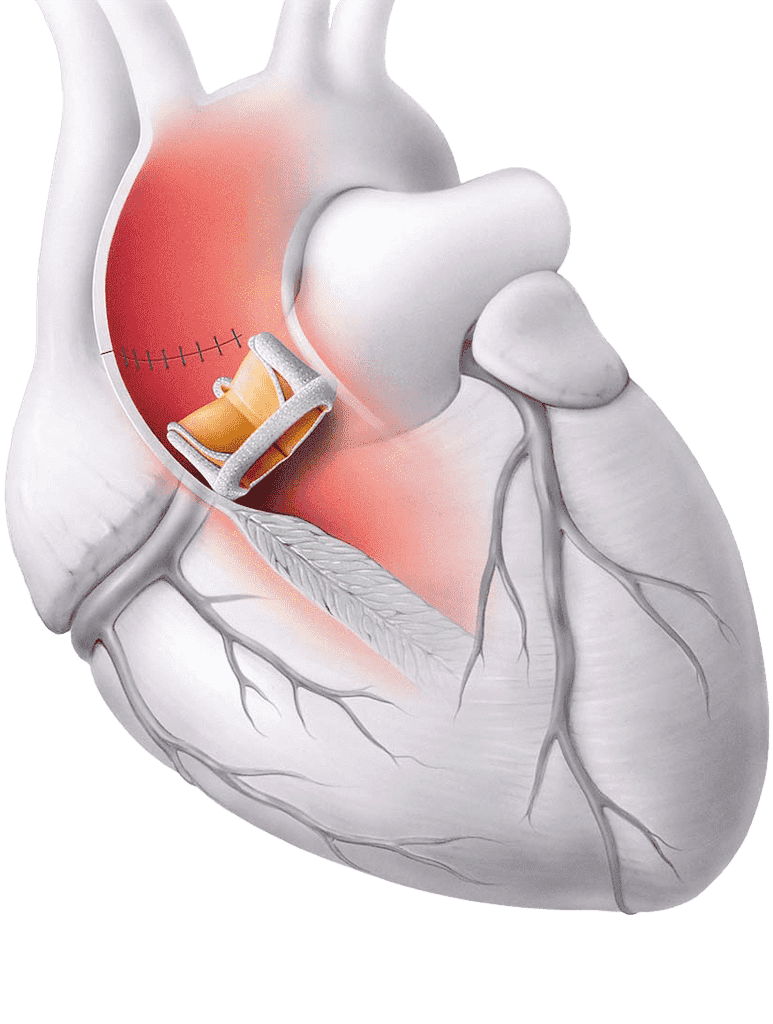
The aortic valve lies between the left ventricle and the aorta. It opens with each heartbeat to let blood out to the rest of the body, then closes. Over time it can become narrowed (aortic stenosis) or leaky (aortic regurgitation). Surgery consists of replacing the valve with a prosthesis, or repairing it in selected cases.
Step by step
- 1
The work-up includes an echocardiogram and, in most cases, a coronary angiography (an examination of the heart's arteries through a catheter, performed under local anaesthesia while you are awake). The type of prosthesis, mechanical or biological, is discussed with you.
- 2
The operation is performed under general anaesthesia. You are asleep for its entire duration.
- 3
The surgeon reaches the heart through an incision in the middle of the chest (sternotomy), sometimes through a shorter approach (mini-sternotomy).
- 4
A heart-lung machine temporarily takes over circulation and oxygenation while the valve is being worked on.
- 5
The diseased valve is removed, then the chosen prosthesis is fitted and secured in its place. In selected cases, repair of the valve is possible.
- 6
The function of the prosthesis is checked by echocardiography, then the chest is closed. You are transferred to intensive care for monitoring during the first hours.
Benefits and expected outcome
The aim is to relieve the obstruction or stop the leak so that the left ventricle works under normal conditions. In most patients, breathlessness, chest pain and dizziness related to the narrowing decrease. The choice between a mechanical and a biological prosthesis takes into account your age, your medication and your way of life.
Recovery and follow-up
Hospital stay is generally about a week, the first days in intensive care. Activity is resumed under the team's supervision and the breastbone heals in around two months. A mechanical prosthesis requires lifelong anticoagulant treatment with regular blood tests; a biological prosthesis does not require prolonged anticoagulation in most cases. Regular cardiology follow-up with echocardiography is necessary.
This page is for information and does not replace a medical consultation. Each situation is different and is assessed individually.
Appointment
An opinion on your situation?
Don't wait to talk about it: book an appointment.