
Heart valve surgery
Valve repair
Valve repair (valvuloplasty), preferred whenever possible in order to preserve the patient's own valve.
What is it?
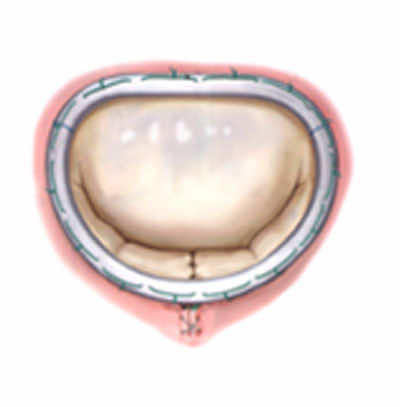
Valve repair is the reconstruction of a heart valve, as opposed to replacing it with a prosthesis. The surgeon corrects the mechanism of the leak: work on the leaflets, work on the cords that support the valve, and placement of a prosthetic ring to restore the valve's normal dimensions. Repair is preferred whenever the anatomy of the valve allows it, particularly for the mitral and tricuspid valves.
Step by step
- 1
An echocardiogram, often completed by a probe passed through the oesophagus, analyses the mechanism of the leak and determines whether repair is feasible.
- 2
The operation is performed under general anaesthesia. You are asleep for its entire duration.
- 3
The surgeon reaches the heart through the chest: a sternotomy or, in selected cases, a short side incision.
- 4
A heart-lung machine temporarily takes over circulation and oxygenation.
- 5
The valve is repaired according to the identified mechanism: work on the leaflets, work on the supporting cords, and placement of a prosthetic ring.
- 6
The result is checked by echocardiography before closure. If the repair is not satisfactory, the valve is replaced with a prosthesis during the same operation; this possibility is explained to you beforehand.
Benefits and expected outcome
Repair preserves your own valve and the ventricular structures attached to it. In most cases it avoids the lifelong anticoagulant treatment required by a mechanical prosthesis. The aim is to restore correct closure of the valve and reduce the workload of the heart.
Recovery and follow-up
The postoperative course is that of cardiac surgery: a few days in hospital, including a period in intensive care. Walking and then activity are resumed according to the team's instructions; the breastbone heals in about two months. Anticoagulant treatment is prescribed for a few weeks in some cases, then reassessed. A control echocardiogram checks that the repair is holding, after which annual cardiology follow-up is arranged.
This page is for information and does not replace a medical consultation. Each situation is different and is assessed individually.
Appointment
An opinion on your situation?
Don't wait to talk about it: book an appointment.