
Interventional cardiology
TAVI — aortic valve by catheter
Transcatheter aortic valve replacement (TAVI), without opening the chest.
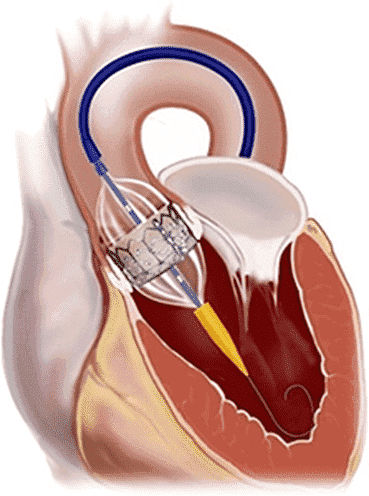
What is it?
The aortic valve controls the flow of blood out of the heart into the aorta. With age it can thicken and calcify, so it opens less well; this is called aortic stenosis. TAVI places a replacement valve using a catheter (a thin, flexible tube), without opening the chest. It is offered after assessment by a team of cardiologists and surgeons.
Step by step
- 1
Assessment beforehand includes a heart ultrasound, a CT scan and a coronary angiogram, in order to select the type and size of the valve.
- 2
Your case is discussed at a joint medical and surgical meeting, which confirms that TAVI is the indicated technique in your case.
- 3
On the day of the procedure, a local anaesthetic at the puncture site is combined with light sedation. You remain conscious in the great majority of cases; general anaesthesia is used only in certain specific situations.
- 4
A puncture is made in the femoral artery at the groin, and the catheter is advanced to the aortic valve under X-ray guidance.
- 5
The replacement valve, folded inside the catheter, is positioned and then expanded within the diseased valve, pushing it against the wall.
- 6
The catheter is withdrawn and the puncture site is closed. The function of the new valve is checked by ultrasound.
Benefits and expected outcome
Because the chest is not opened and no heart-lung machine is used, the hospital stay is usually shorter. The aim is to restore the opening of the valve and to reduce the breathlessness caused by the stenosis. The technique makes it possible to treat patients for whom conventional surgery would carry a higher risk.
Recovery and follow-up
Monitoring after TAVI usually lasts a few days and covers the heart rhythm and the puncture site in particular. Most patients walk again from the following day. Antiplatelet or anticoagulant medication is prescribed according to your situation. Follow-up ultrasound checks are then scheduled to monitor the valve.
This page is for information and does not replace a medical consultation. Each situation is different and is assessed individually.
Appointment
An opinion on your situation?
Don't wait to talk about it: book an appointment.