
Interventional cardiology
Coronary angiography
Imaging examination of the coronary arteries performed by catheter, under local anaesthesia.
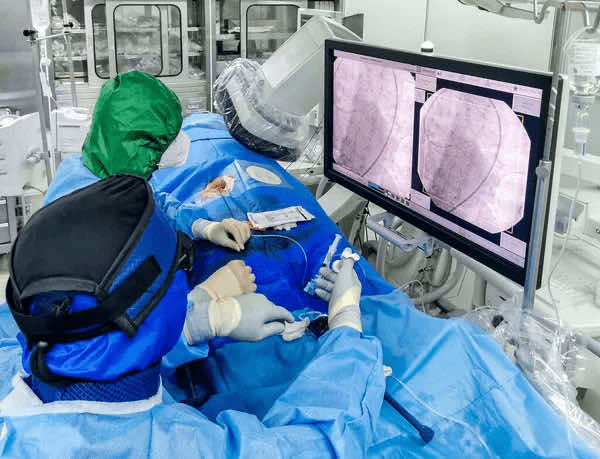
What is it?
Coronary angiography is an examination that shows the inside of the coronary arteries, the vessels that supply blood to the heart muscle. A catheter (a thin, flexible tube) is introduced into an artery at the wrist or the groin and advanced to the heart. Contrast dye is injected and X-ray images are recorded. The examination is performed under local anaesthesia: you remain awake from start to finish.
Step by step
- 1
You lie on your back on the examination table. An intravenous line is placed and you are connected to monitoring of your heart rhythm and blood pressure.
- 2
Local anaesthetic numbs the skin, usually at the wrist and sometimes at the groin. You remain awake throughout the examination.
- 3
The catheter is introduced through this entry point and advanced to the origin of the coronary arteries. Its passage through the vessels is not painful.
- 4
Contrast dye is injected and X-ray sequences are recorded from several angles. A brief sensation of warmth may occur as the dye is injected.
- 5
The doctor reviews the images and identifies the site and the degree of any narrowings.
- 6
The catheter is removed and a compression device is applied to the puncture site. The results are explained to you at the end of the examination.
Benefits and expected outcome
The examination gives a direct image of the coronary arteries, which non-invasive tests cannot always provide. It defines the site and severity of any lesions and guides the choice between medication, angioplasty and surgery. If a treatable lesion is found, angioplasty can sometimes be carried out during the same session, with your consent.
Recovery and follow-up
After coronary angiography through the wrist, you are usually allowed to get up within a few hours. Through the groin, several hours lying flat are needed before you get up. You are advised to drink fluids to help clear the contrast dye and to avoid exertion for one to two days. You leave with the report and with instructions for checking the puncture site.
This page is for information and does not replace a medical consultation. Each situation is different and is assessed individually.
Appointment
An opinion on your situation?
Don't wait to talk about it: book an appointment.