
Coronary surgery
Coronary artery bypass
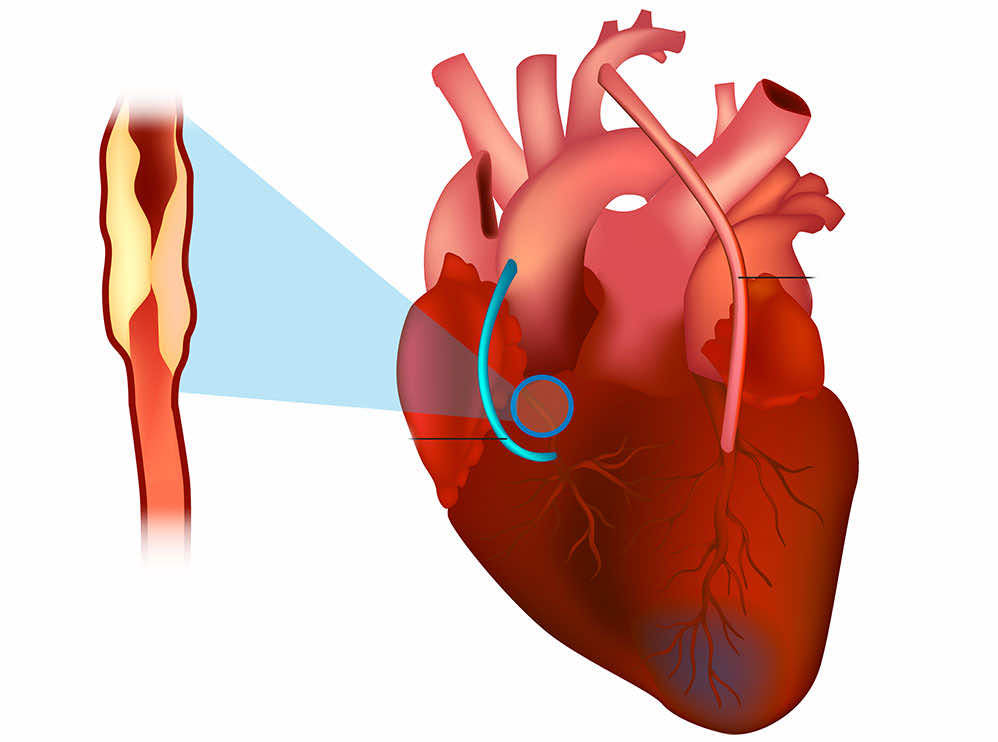
Restoring blood flow to the heart muscle by bypassing the narrowed or blocked coronary artery with a graft taken from the patient.
What is it?
The coronary arteries supply blood to the heart muscle. When one of them narrows or becomes blocked, the heart muscle no longer receives enough blood. Coronary artery bypass grafting creates a new route for the blood, using a vessel taken from your own body (a graft) attached beyond the blocked segment. The aim is to restore the blood supply to the heart.
Step by step
- 1
Before surgery, you meet the surgeon and the anaesthetist. The work-up (coronary angiography, echocardiogram, blood tests) determines the number and position of the bypasses.
- 2
The operation is performed under general anaesthesia. You are asleep for its entire duration.
- 3
The surgeon takes one or more vessels, usually an artery from the chest wall or a vein from the leg, to be used as grafts.
- 4
The heart is reached through an incision in the middle of the chest (sternotomy). The procedure may be carried out on the beating heart or with a heart-lung machine that temporarily takes over circulation and oxygenation.
- 5
Each graft is connected to the coronary artery beyond the narrowing, restoring the flow of blood.
- 6
The surgeon checks that the grafts are working, then closes the chest. You are transferred to intensive care for monitoring during the first hours.
Benefits and expected outcome
The aim of a bypass is to restore the blood supply to the heart muscle. In most patients, angina (chest pain on exertion) decreases and exercise tolerance improves. The bypass is part of overall management that includes medication and control of risk factors.
Recovery and follow-up
Hospital stay is usually a few days, the first of them in intensive care. Getting up and walking are resumed gradually, following a protocol set by the team. The breastbone takes about two months to heal: lifting heavy loads and driving are restricted during this period. A cardiac rehabilitation programme and follow-up appointments are then arranged.
This page is for information and does not replace a medical consultation. Each situation is different and is assessed individually.
Appointment
An opinion on your situation?
Don't wait to talk about it: book an appointment.