
Interventional cardiology
Coronary angioplasty
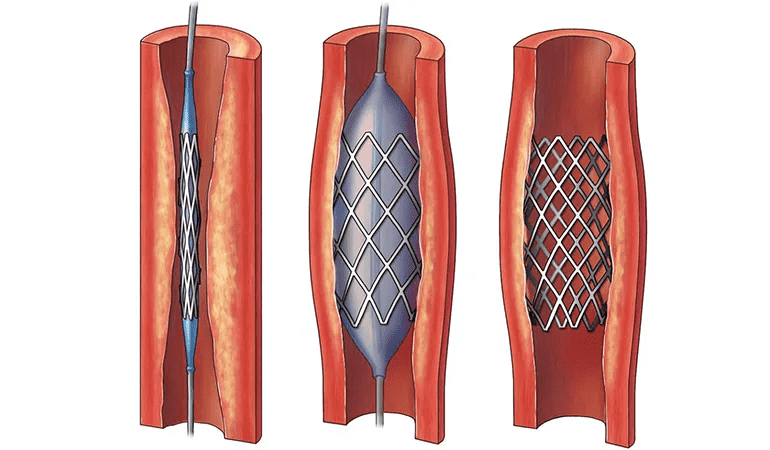
Dilation of a narrowed coronary artery with a balloon and stent placement, via catheter.
What is it?
Coronary angioplasty treats a narrowing or a blockage in one of the heart's arteries. A balloon mounted on a catheter is advanced to the lesion and inflated to widen the passage. A stent, a small metal mesh, is usually placed to keep the artery open. The procedure is carried out through an artery, under local anaesthesia and without opening the chest: you remain awake.
Step by step
- 1
You lie on your back with monitoring in place. Antiplatelet medication is given before the procedure.
- 2
Local anaesthetic numbs the skin at the wrist or at the groin. You remain awake throughout the procedure.
- 3
A catheter is introduced through this entry point and positioned at the opening of the affected coronary artery. A very fine guidewire is then passed across the lesion.
- 4
A balloon is advanced over the wire and inflated for a few seconds at the narrowing. Brief chest discomfort may occur during inflation; tell the team if you feel it.
- 5
A stent is deployed at the same site to hold the artery open. The result is checked with a further injection of contrast dye.
- 6
The equipment is removed and the puncture site is compressed. You then stay under observation, with heart rhythm monitoring.
Benefits and expected outcome
The aim is to restore blood flow in the treated artery. Most patients notice a reduction in chest pain and in breathlessness on exertion. Because there is no chest incision, the hospital stay is short, often limited to one night.
Recovery and follow-up
You rest for a few hours after the procedure, with monitoring of the puncture site. Usual activities are resumed over a few days, according to your doctor's instructions. The antiplatelet medication prescribed after a stent must not be stopped without medical advice. A follow-up consultation and management of your risk factors complete the treatment.
This page is for information and does not replace a medical consultation. Each situation is different and is assessed individually.
Appointment
An opinion on your situation?
Don't wait to talk about it: book an appointment.