
Aortic surgery
Aortic aneurysm
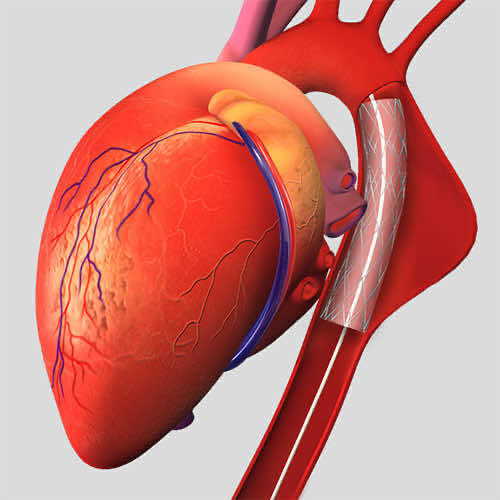
Dilation of the aortic wall, monitored and then treated by endovascular or open surgery depending on the case.
What is it?
The aorta is the large artery that leaves the heart and supplies the whole body. An aneurysm is a permanent widening of its wall along one segment. It usually develops without symptoms and is found during an imaging test. What happens next depends on the measured diameter, how fast it is growing, and your general health.
Step by step
- 1
A consultation is used to review your medical history, your blood pressure and the factors that influence how the aneurysm develops.
- 2
The diameter of the aorta is measured by ultrasound or CT angiography (a cross-sectional X-ray with contrast dye). This measurement is the reference for later checks.
- 3
If the diameter stays below the treatment threshold, surveillance is the chosen approach: repeat imaging at set intervals, blood pressure control and stopping smoking.
- 4
Above that threshold, or if the aneurysm grows quickly, treatment is indicated. The choice between an endovascular procedure and open surgery depends on the location of the aneurysm and on your anatomy.
- 5
The endovascular procedure passes a stent graft (a reinforced tube) through the femoral artery at the groin to line the aorta from the inside; anaesthesia is local, regional or general depending on the case.
- 6
Open surgery, performed under general anaesthesia, replaces the widened segment with a vascular graft. In both cases, follow-up imaging is scheduled.
Benefits and expected outcome
The aim of surveillance is to measure how the aneurysm changes and to intervene at the point where treatment is indicated, neither too early nor too late. The aim of treatment is to reinforce the widened segment so that it can withstand blood pressure. The choice of technique is discussed with you before any decision is made.
Recovery and follow-up
After an endovascular procedure, the hospital stay is usually a few days and the return to activity is quick. After open surgery, the stay is longer and convalescence extends over several weeks. In both cases, a follow-up scan is scheduled and then repeated to a set timetable. Blood pressure control remains essential.
This page is for information and does not replace a medical consultation. Each situation is different and is assessed individually.
Appointment
An opinion on your situation?
Don't wait to talk about it: book an appointment.